LangChain
The LangChain instrumentation traces chains, LLM calls, tools and retrievers, including LangGraph agents.
Oodle is a managed observability platform for metrics, logs, traces and agent traces. It ingests OpenTelemetry natively, so the snippet on this page is the complete setup.
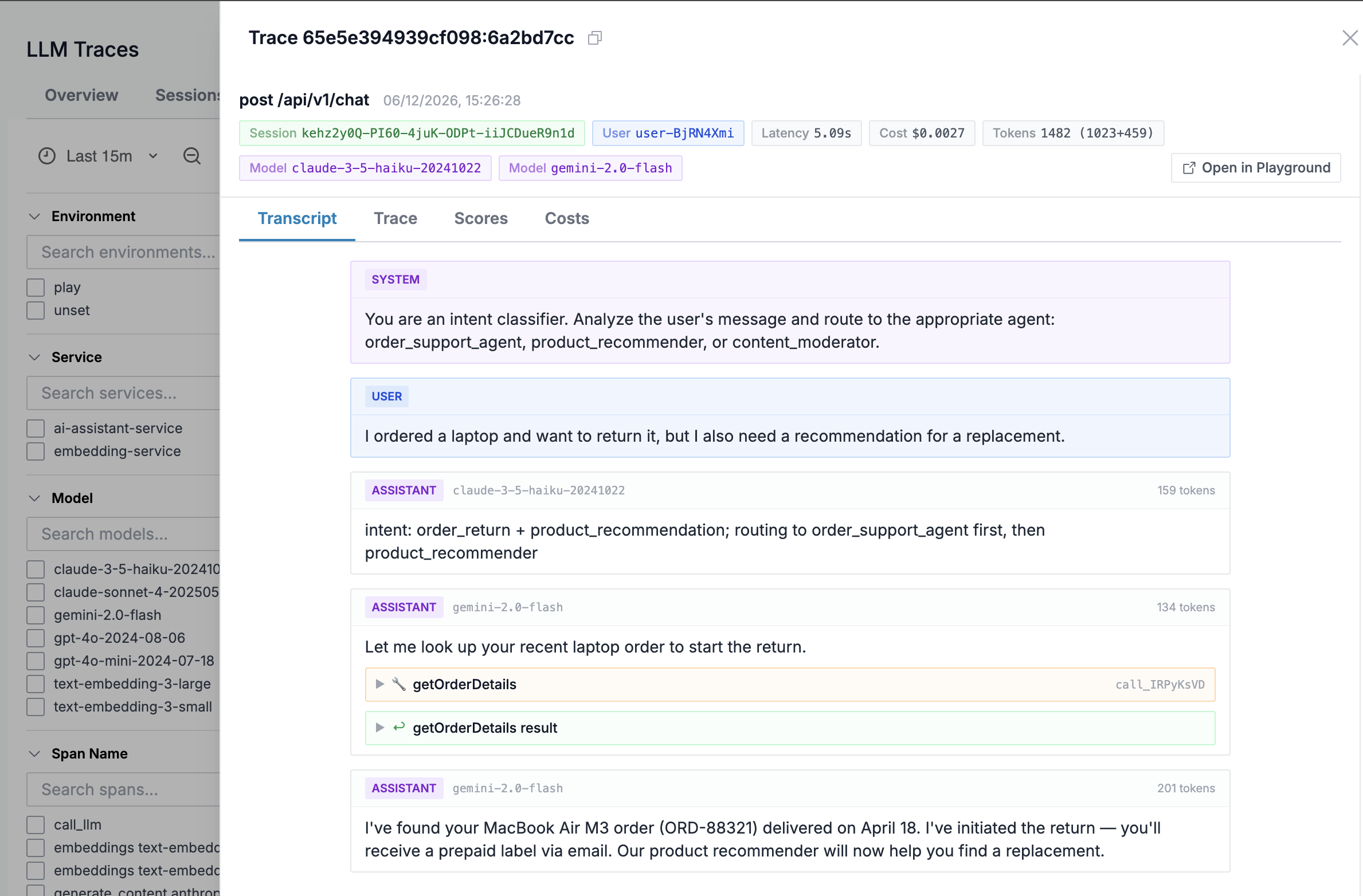
Each trace shows the full transcript, the token counts and cost of every call, the agent structure (runs, steps and tool calls) and Signals: labels for loops, rate limits, refusals and tool failures, detected as the trace arrives.
Sign up for free to get an instance ID and an API key, or see the Agent Observability overview first.
You will need:
OODLE_INSTANCE: your Oodle instance ID (ap1, us1)OODLE_API_KEY: an Oodle API key (ap1, us1)OTLP_ENDPOINT: your OTLP collector domain, shown on the tile
Open the LangChain tile on the ap1, us1 page to
get these filled in for you, or let an agent do the setup with
/oodle-onboarding set up the llm_observability_langchain integration.
Python
Install
Install LangChain, LangGraph, and the LangChain OTel instrumentor:
pip install langchain langchain-openai langgraph \
  opentelemetry-instrumentation-langchain \
  opentelemetry-exporter-otlp-proto-http \
  opentelemetry-sdk
Instrument
Initialize OpenTelemetry and activate the LangChain instrumentor. It auto-instruments chains, LLM calls, tools, and retrievers:
from langchain.agents import create_agent
from langchain_openai import ChatOpenAI
from opentelemetry.exporter.otlp.proto.http.trace_exporter import OTLPSpanExporter
from opentelemetry.instrumentation.langchain import LangchainInstrumentor
from opentelemetry.sdk.resources import Resource
from opentelemetry.sdk.trace import TracerProvider
from opentelemetry.sdk.trace.export import BatchSpanProcessor
from opentelemetry.trace import set_tracer_provider


def setup_opentelemetry():
    resource = Resource.create({"service.name": "my-llm-app"})

    tracer_provider = TracerProvider(resource=resource)
    tracer_provider.add_span_processor(
        BatchSpanProcessor(OTLPSpanExporter())
    )
    set_tracer_provider(tracer_provider)


setup_opentelemetry()

# Auto-instruments LangChain chains, LLM calls, tools,
# and retrievers. No manual spans required.
LangchainInstrumentor().instrument()

agent = create_agent(ChatOpenAI(model="gpt-4o-mini"), tools=[])
Environment
Point the application at Oodle:
# OTLP endpoint (points straight at Oodle)
export OTEL_EXPORTER_OTLP_ENDPOINT=https://<OTLP_ENDPOINT>

export OTEL_EXPORTER_OTLP_HEADERS="X-API-KEY=<OODLE_API_KEY>,X-OODLE-INSTANCE=<OODLE_INSTANCE>"

# Compress the export: prompt payloads are large
export OTEL_EXPORTER_OTLP_COMPRESSION=gzip

# Optional: disable prompt/response capture
# export TRACELOOP_TRACE_CONTENT=false
TypeScript / JavaScript
Install
Install LangChain, LangGraph, and the LangChain OTel instrumentor:
npm install @traceloop/instrumentation-langchain \
  @opentelemetry/api \
  @opentelemetry/instrumentation \
  @opentelemetry/exporter-trace-otlp-proto \
  @opentelemetry/resources \
  @opentelemetry/sdk-trace-base \
  @opentelemetry/sdk-trace-node \
  @opentelemetry/semantic-conventions \
  langchain @langchain/openai @langchain/core zod
Instrument
Initialize OpenTelemetry and activate the LangChain instrumentor. It auto-instruments chains, LLM calls, tools, and retrievers:
// instrumentation.js
const { LangChainInstrumentation } = require('@traceloop/instrumentation-langchain');
const { registerInstrumentations } = require('@opentelemetry/instrumentation');
const { OTLPTraceExporter } = require('@opentelemetry/exporter-trace-otlp-proto');
const { resourceFromAttributes } = require('@opentelemetry/resources');
const { BatchSpanProcessor } = require('@opentelemetry/sdk-trace-base');
const { NodeTracerProvider } = require('@opentelemetry/sdk-trace-node');
const { ATTR_SERVICE_NAME } = require('@opentelemetry/semantic-conventions');

const provider = new NodeTracerProvider({
  resource: resourceFromAttributes({ [ATTR_SERVICE_NAME]: 'my-llm-app' }),
  spanProcessors: [new BatchSpanProcessor(new OTLPTraceExporter())],
});
provider.register();

// Auto-instruments chains, LLM calls, tools, and retrievers.
registerInstrumentations({ instrumentations: [new LangChainInstrumentation()] });

process.on('beforeExit', () => provider.shutdown());

// app.js
const { trace } = require('@opentelemetry/api');
const { createAgent } = require('langchain');
const { tool } = require('@langchain/core/tools');
const { z } = require('zod');

const tracer = trace.getTracer('my-llm-app');

const getWeather = tool(async ({ city }) => `Sunny in ${city}`, {
  name: 'get_weather',
  description: 'Return the weather for a city.',
  schema: z.object({ city: z.string() }),
});

const agent = createAgent({ model: 'openai:gpt-4o-mini', tools: [getWeather] });

async function main() {
  // The LangChain spans join the span that is active when they
  // start. Open one per run so the model calls and tool calls
  // arrive as one trace; under an instrumented HTTP server the
  // request span already does this.
  const result = await tracer.startActiveSpan(
    'invoke_agent weather-agent',
    {
      attributes: {
        'gen_ai.operation.name': 'invoke_agent',
        'gen_ai.agent.name': 'weather-agent',
      },
    },
    async (span) => {
      try {
        return await agent.invoke({
          messages: [{ role: 'user', content: 'What is the weather in Paris?' }],
        });
      } finally {
        span.end();
      }
    }
  );
  console.log(result.messages.at(-1).content);
}

main();
Environment
Point the application at Oodle:
# OTLP endpoint (points straight at Oodle)
export OTEL_EXPORTER_OTLP_ENDPOINT=https://<OTLP_ENDPOINT>

export OTEL_EXPORTER_OTLP_HEADERS="X-API-KEY=<OODLE_API_KEY>,X-OODLE-INSTANCE=<OODLE_INSTANCE>"

# Compress the export: prompt payloads are large
export OTEL_EXPORTER_OTLP_COMPRESSION=gzip

# Load the instrumentation before your app, so LangChain is
# patched as it loads.
node --require ./instrumentation.js app.js
Verify
Run your application, then open ap1, us1. Spans
carry gen_ai.* attributes: the model, token counts, and the prompt and
response content. Click a trace for the Transcript, the waterfall, and
the cost breakdown.
If nothing arrives, check that the exporter can reach
https://<OTLP_ENDPOINT> and that the instance and key are set: the
OTLP gateway answers 401 without them.
Support
If you need assistance or have any questions, please reach out to us through:
- Email at [email protected]